
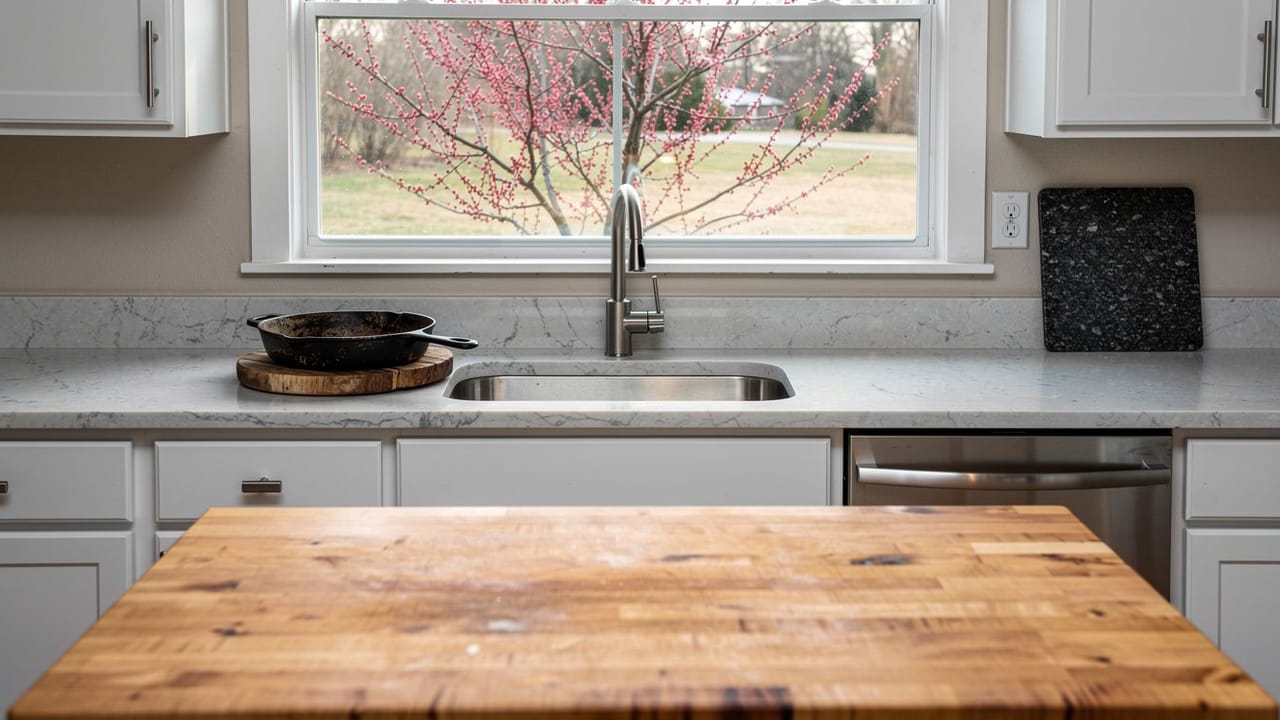
· by Michael Blair, Nashville's Kitchen & Bath
Every countertop material looks good on the day it is installed. What separates them is how they behave against heat, acid, water and five years of ordinary use. Here’s what the makers and the stone trade publish about each, and what we check before a top is ordered through our cabinets and countertops service.
Quartz
Engineered stone. Cambria’s product guide specification lists its slabs as quartz, binder and pigment, and reports them unaffected in the ASTM stain resistance test. According to Cambria’s care page, its quartz is nonporous and never needs sealing, and owners are told not to put sealers or topical treatments on it under any circumstances. Those statements are one maker’s, about its own product. For any other brand we read that brand’s care sheet before you settle on it.
The weakness is heat. Cambria says outright that its quartz isn’t heat-proof and recommends a closed-weave hot pad or a solid trivet under pots and pans, griddles, slow cookers and air fryers. So a pan straight off the stove goes on a trivet, every time. If a stretch of counter sits in strong sun under a big south-facing window, ask the manufacturer what it says about sunlight before you order.
Granite
Natural stone. The Natural Stone Institute’s care and cleaning guide says many stones can withstand heat and still recommends trivets or mats, so the habit is the same one we’d ask for on quartz.
Granites differ in how porous they are. The institute’s page on caring for granite recommends sealing most of them, with the timing depending on how the counter is used and which sealer went on, and it notes that a dense stone such as Absolute Black may need a single application or none. Sealing only makes stone more resistant to stains. An oil stain darkens the stone and normally has to be dissolved out chemically, the care guide says, which is why a porous granite beside the range or under the coffee maker is where to be careful.
How should I judge butcher block, solid surface or laminate?
With wood, solid surface and laminate, we go by the care and warranty sheet for the exact product, and we get it before the material is chosen. For a wood top the questions are how it’s finished, how that finish gets renewed, and whether the maker is happy to have it next to a sink.
For solid surface, ask whether scratches and heat marks can be repaired in place and who does it. For laminate, ask how the seams are made and what the maker says about water at those seams. A top that sounds right in the showroom and has no answer to these is one we’d steer you away from.
- Quartz (Cambria’s): no sealer, a trivet under anything hot
- Granite: trivets recommended, sealing set by the stone and the sealer
- Butcher block: ask how it’s finished and how the finish is renewed
- Solid surface: ask what can be repaired in place
- Laminate: ask about the seams and water
What should I check before ordering a countertop?
Seam placement. Where the joints fall is a design decision, made on the layout before anything is cut. Cambria’s specification has fabricators lay out the surface to minimize joints, keep each joint no wider than 1/32 inch, and use digital layout for seam coordination. Ask to see every seam on the drawing.
Edge profile and overhang support. The same specification puts the edge profiles, cutouts and the locations of supports and blocking on the shop drawings, and has the installer confirm the supports are in place before the top goes down. How an island overhang is held up gets settled on paper, before fabrication. If an island is part of the plan, our post on adding a kitchen island covers the clearances, power and plumbing that come with it, and you can book a free estimate to have us measure the run.
Sources
- Cambria, Product Care — Cambria quartz is nonporous and never needs sealing; no sealers or topical treatments; not heat-proof; closed-weave hot pad or solid trivet under pots and pans
- Cambria, CSI Guide: Counter and Horizontal Surface (product guide specification) — Quartz, binder and pigment; ASTM C1378 stain resistance unaffected; lay out to minimize joints no wider than 1/32 inch; digital seam coordination; supports and blocking on drawings and verified before install
- Natural Stone Institute, Care and Cleaning — Many stones withstand heat but trivets or mats are recommended; sealing makes stone more stain resistant, not stain proof; oil stains darken stone and normally must be chemically dissolved
- Natural Stone Institute (Use Natural Stone), Caring for Granite — Some granites more porous than others; sealing recommended for most, timing varies by use and sealer; Absolute Black may need one application or none; hot water test for 10 to 20 minutes
FAQ
Quartz, Granite or Butcher Block — questions
Does quartz need sealing?
Not Cambria’s. The maker says its quartz is nonporous and never needs sealing, and tells owners not to apply sealers at all; other brands publish their own care sheets. What it does need is protection from heat. Cambria says it is not heat-proof and recommends a hot pad or solid trivet under pots and pans, and its care page offers no repair for heat damage, so treat a mark as something to prevent.
How often should granite be sealed?
It depends on the stone and the sealer. The Natural Stone Institute recommends sealing most granites, with timing that varies by use and product, and says some dense stones such as Absolute Black may need one application or none. Its test is to put a little hot water on the surface, leave it for 10 to 20 minutes and wipe it off. If the stone has darkened, it is still absorbing moisture; if it has not, it is sealed.
Is butcher block practical around a sink?
That depends on how the top is finished and what its maker allows, so we go by the care instructions for that exact top. Where a maker is cautious about water, many people keep wood for an island or a baking area and run stone or quartz along the sink, which is a sensible compromise.
Is quartz or granite more durable?
Neither wins outright, since they wear differently. Cambria’s quartz tested unaffected for staining and needs no sealer, but its maker says it isn’t heat-proof. Many granites handle heat better, yet most need sealing to resist stains, and an oil stain usually has to be drawn out chemically. Both makers advise a trivet under hot pans.