
· by Michael Blair, Nashville's Kitchen & Bath
People who search for cabinet refacing usually have a kitchen that works but looks its age, and a sense that tearing out every cabinet is more than it needs. Sometimes that sense is right. Refacing is one of three ways to change how cabinets look, alongside painting the existing doors and frames and replacing the cabinets outright, and the choice between them is decided less by taste than by what is behind the doors. This is how we sort it out when a kitchen comes to our cabinets and countertops work, and what changes the answer in a house that was built before 1978.
What refacing keeps and what it replaces
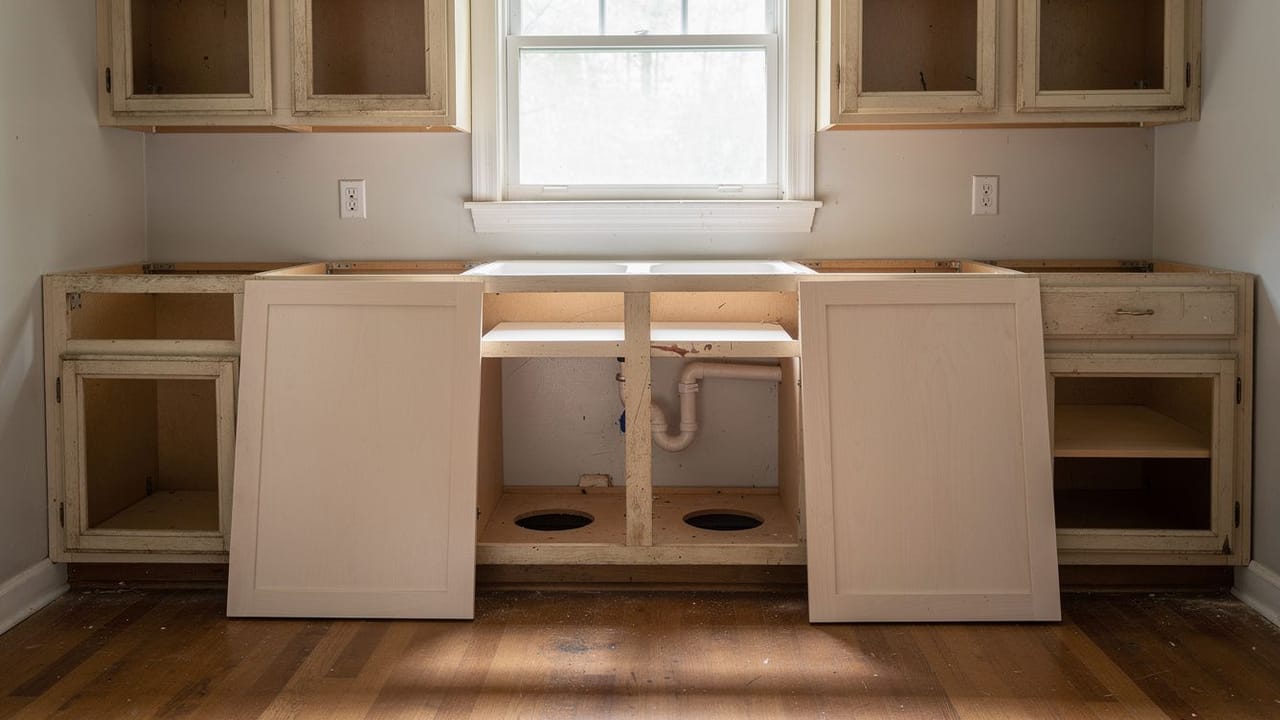
A kitchen cabinet is a box with a face on it. The box is the sides, back, bottom and shelves, fixed to the wall or the floor and carrying the countertop and the sink. The face is the frame around the opening, if the cabinet has one, and the doors and drawer fronts hung on it. Refacing keeps every box where it stands and changes only the face: new doors and drawer fronts, new veneer or laminate over the exposed frames and end panels so they match, and usually new hinges and pulls to go with them.
Because the boxes stay, so does almost everything attached to them. The countertop can stay on, the sink and faucet stay connected, the dishwasher stays in its opening, and the wall behind the cabinets is never opened. That is the case for refacing: the look changes and the kitchen goes on working around the job. It is also the limit of it. The footprint does not move, the cabinet sizes do not change, and a drawer box that sticks or a shelf that sags is still there unless it is replaced along with the fronts.
Painting keeps even more. The existing doors and frames are cleaned, sanded and refinished in place or in a shop, and nothing new is hung. It suits solid doors with a profile you still like. Replacing takes everything out down to the wall and starts again, which is the only one of the three that lets the room change shape.
When the boxes rule refacing out
New fronts on a failing box are money spent twice. Before anyone measures for doors, we open every base cabinet and look at its floor, its back and its sides, and two places get the most attention: the sink base and the cabinets on either side of the dishwasher. Those are where water reaches a box, from a slow drip at a supply valve, a dishwasher that has wept at its door seal for years, or steam from the dishwasher vent rising into the counter above. Middle Tennessee summers keep the air under a sink damp on top of that.
Many builder-grade boxes are particleboard, and particleboard that has taken on water swells, softens and loses its grip on screws. A sink base with a swollen, crumbling floor is replaced whatever happens to the rest of the kitchen. If one or two boxes are bad and the others are sound, it can still make sense to replace those two and reface the run around them. If the damage is spread through the kitchen, or the face frames are loose from the boxes, replacement is the honest answer.
The other thing that rules refacing out has nothing to do with the cabinets. If you want the sink under a different window, a wider refrigerator opening, an island, or a wall gone, the boxes have to come out anyway. That is the first question worth answering, because kitchen layout mistakes that are hard to undo are much harder to fix once new fronts are on the old footprint, and a plan that moves walls belongs with our walls, islands and layout changes work. If the layout is right and the boxes are sound, refacing or painting fits in with the paint, hardware and lighting of a refresh project.
Older painted cabinets and the lead rule
A lot of Nashville housing went up before 1978, and plenty of it still has its original kitchen or trim with old paint under the newer coats. That date matters because of the federal lead rule. The EPA’s Renovation, Repair and Painting Program page says anyone paid to do work that disturbs painted surfaces in a home built before 1978 has to be certified and follow lead-safe work practices, sole proprietors included. The same page says about three-quarters of US homes built before 1978 still contain some lead-based paint. A homeowner working on their own house is generally not covered; anyone you hire is.
Painting and refacing both disturb paint. Painting means sanding the doors and frames to get the new finish to bond. Refacing means scuffing the frames so veneer adheres, cutting and trimming at the edges, and pulling off old moldings. The work practice standards in 40 CFR 745.85 set out what that looks like on an interior job: the work area isolated so dust and debris do not leave it, plastic on the floor at least 6 feet beyond the surfaces being worked on, ducts in the work area covered, and warning signs up until cleaning has been verified afterward.
The same section prohibits torching painted surfaces, holds heat guns below 1,100 degrees Fahrenheit, and bars high-speed sanding, grinding or planing of painted surfaces unless the machine has a shroud or containment and a HEPA vacuum attachment. For cabinets that means the prep is slower and more contained than on a newer house, and doors are often better taken to a shop than sanded in the kitchen. Replacing old painted cabinets disturbs paint too, at the demolition, so the rule applies whichever way you go.
What to ask before you choose
If you are leaning toward new cabinets, ask what they are certified to. KCMA’s Quality Cabinet Certification tests a cabinet design’s structure, drawers, doors and finish to simulate a lifetime of use, and the cabinets have to look and work as new afterward. A line that carries it has been through that testing; one that does not may still be well made, but you are taking the seller’s word for it.
Ask about the panels inside, too. Cabinet boxes and many doors are made from particleboard, medium-density fiberboard or hardwood plywood, and the EPA’s formaldehyde emission standards for composite wood products cover those panels and household goods made from them. Since March 22, 2019, composite wood products have had to be labeled TSCA Title VI compliant, so new cabinets and the panels used in a refacing job should be able to show that label.
Then ask the questions that apply whichever way you go. Is the firm doing the work certified under the lead rule, if the house was built before 1978? Which boxes will be replaced, and why? Do the countertops stay, and if not, has the material been chosen, since our comparison of quartz, granite and butcher block bears on what the new boxes have to carry? And is the contractor licensed? The Tennessee Contractors Licensing Board lists the license types, including home improvement contractors, and links to a tool for verifying a license. When you want someone to open the cabinet doors and look, ask for an estimate and we will start under the sink.
Sources
- EPA, Renovation, Repair and Painting Program — Certification for paid work that disturbs paint in pre-1978 homes; share of pre-1978 homes with lead paint.
- eCFR, 40 CFR 745.85, Work practice standards — Interior containment, floor covering, signs and prohibited practices on painted surfaces.
- EPA, Formaldehyde Emission Standards for Composite Wood Products — Panels and finished goods covered; TSCA Title VI labeling since March 22, 2019.
- KCMA, Quality Cabinet Certification — What a certified cabinet design is tested for.
- Tennessee Department of Commerce and Insurance, Contractors Licensing Board — License types and the license verification tool.