
· by Michael Blair, Nashville's Kitchen & Bath
An acrylic surround comes as one molded piece or a few, with a factory-made base and very few joints. A tiled shower is built on site in layers, and the layer that keeps the house dry is one you never see again once the tile is up. Both are legitimate: the plumbing fixtures chapter of the residential code Nashville enforces lists the waterproof linings allowed under a shower floor built on site, and a molded base is a receptor of its own. The risks simply sit in different places.
What are the advantages of an acrylic shower?
Fewer places for water to get in. A one-piece or three-piece surround has no grout to maintain and no membrane for an installer to get wrong. The code’s lining rules are written for shower floors built up on site, and chapter 25 of the same code requires that kind of liner to be tested once it is installed; a factory-made base has no liner to test.
Whether it costs less depends on the size of the opening and the product you pick, so we price both side by side when a shower is part of a bathroom remodel instead of assuming. Whatever the surround saves can go to the valve, the trim and the glass, which are the parts you handle every day.
Where tile wins
Tile goes wherever the framing goes. When the opening is an odd size or shape, or the plan has a bench, a niche or a curbless entry, we build it in tile, because the pan and walls are shaped on site and a molded unit only comes in the sizes its maker sells. Most of the tile showers and tub conversions we build start from one of those. Tile or acrylic, the compartment still needs at least 900 square inches of floor and 30 inches in its smallest dimension under section P2708.1.
Tile can also be fixed a piece at a time. When a tile cracks we cut it out and set a new one, and worn grout gets raked out and redone; a crack in a one-piece surround has no single piece to swap.
Do tile and grout make a shower waterproof?
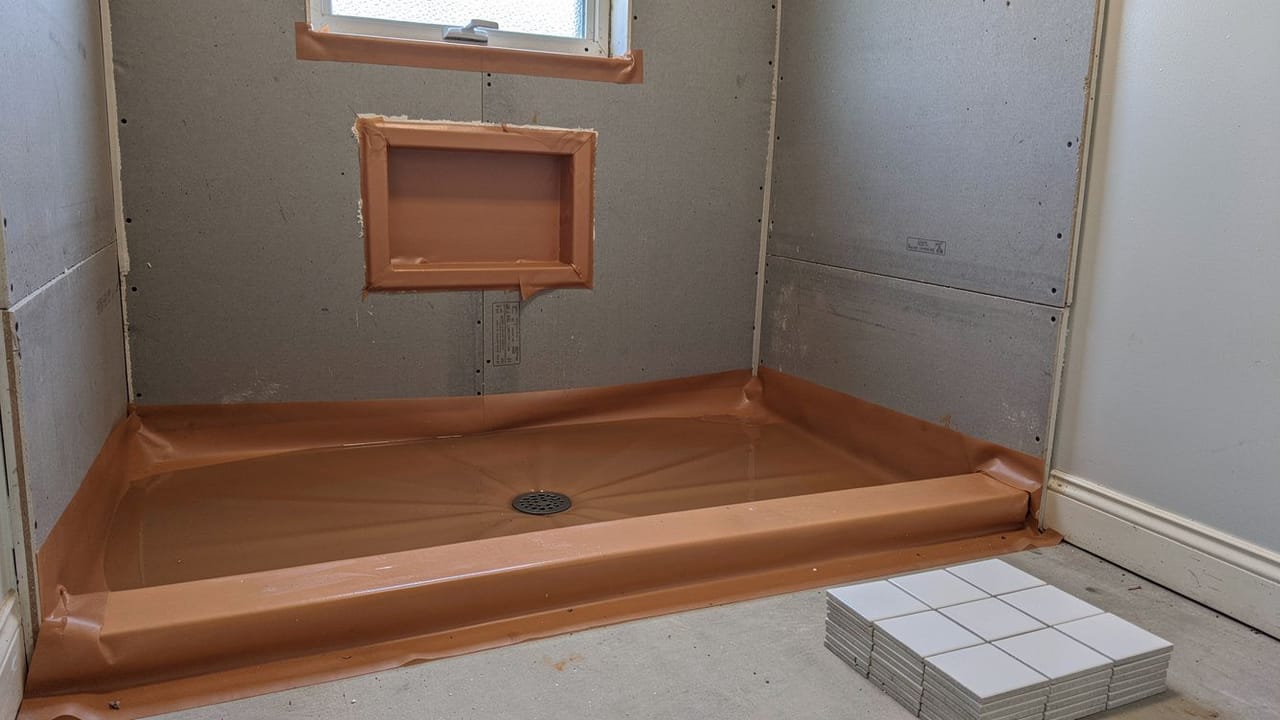
The code doesn’t count on tile and grout to stop water. Section R327.2 asks only that shower walls be finished with a nonabsorbent surface to at least 6 feet above the floor, and the lining under a site-built shower floor is a separate requirement. We work on the same assumption: water will get into the grout, and the membrane behind it is what keeps the framing dry.
Inside Davidson County that code is the 2024 International Residential Code, which Metro adopted in July 2025 under ordinance BL2025-898 and names on its adopted codes list. For the shower floor, section P2709.2 allows sheet lead, sheet copper, a plastic liner, hot-mopping, or a sheet-applied bonded membrane that meets ANSI A118.10, applied to the manufacturer’s instructions. Backer board sits in a different chapter, section R702.4.2 on wall coverings, as a base for wall tile installed to its maker’s recommendations, and it isn’t on the list of linings, so cement board by itself is not the waterproofing.
The details are spelled out too. Under P2709.2 the lining runs at least 2 inches past the rough jambs and 2 inches above the finished threshold, and P2709.1 sets the floor’s fall to the drain at no less than a quarter inch and no more than half an inch per foot. Before tile goes down, P2503.6 has the lined floor filled with 2 inches of water at the threshold and held for at least 15 minutes with no sign of a leak.
- Bonded waterproof membrane over a listed backer board
- Lining carried 2 inches past the jambs and above the finished threshold
- Corners, curb and niche detailed with the same system
- Pan flood-tested with 2 inches of water before tiling
- Floor sloped between 1/4 and 1/2 inch per foot to the drain
- Flexible sealant at changes of plane, not grout
What to ask a contractor
Which waterproofing system, by name, and whether the pan will be flood-tested. Someone who uses a system can name it and tell you they follow its maker’s instructions, and on a site-built pan the test is a code step, so the only good answer to the second question is yes.
Also ask about movement joints. Grout that cracks where two walls meet, or where a wall meets the pan, is often a change of plane that needed a flexible joint instead of grout. If you’d like tile and acrylic priced for your own bathroom, ask us for a free estimate.
Sources
- Metro Nashville Codes, Adopted Codes List — Metro enforces the 2024 International Residential Code
- Metro Nashville Codes, Metro Adopts 2024 International Building Codes (BL2025-898) — The 2024 codes adopted in July 2025 under BL2025-898
- 2024 International Residential Code, Nashville edition, Chapter 27 Plumbing Fixtures (UpCodes) — P2709.2 lining materials and the 2-inch extension past jambs and threshold; P2709.1 slope of 1/4 to 1/2 inch per foot; P2708.1 900 square inches, 30 inches, watertight wall joints
- 2024 International Residential Code, Nashville edition, Chapter 25 Plumbing Administration (UpCodes) — P2503.6 shower liner test: 2 inches of water for at least 15 minutes
- 2024 International Residential Code, Nashville edition, Chapter 3 Building Planning (UpCodes) — R327.2 nonabsorbent shower wall surface to at least 6 feet
- 2024 International Residential Code, Nashville edition, Chapter 7 Wall Covering (UpCodes) — R702.4.2 backer boards for wall tile, installed to the manufacturer’s recommendations
FAQ
Tile or Acrylic for a Nashville Shower — questions
How long does a tiled shower last?
We don’t have a reliable figure to give you, and the tile is rarely what sets the limit. Grout and the silicone joints need attention every so often, while the part that decides whether the shower stays dry is the lining underneath it. That is why we ask about the waterproofing system before we talk about tile.
Is a curbless shower a good idea?
It can be, if it is planned from the start. Without a curb the floor still has to fall to the drain at a quarter inch per foot or more, and the lining still has to carry past the opening, so how the floor gets that slope has to be settled before the plumbing goes in. Done that way it removes the step at the entrance; added late, it is an expensive change.
Does a tiled shower add more resale value than acrylic?
We have not found reliable numbers that separate the two in Nashville home sales, so we won’t promise either one adds more. A clean, well-fitted acrylic surround in a guest bath is no reason to tear it out before listing. For a shower you will use for years, we would choose by the opening, the budget and how the bathroom is used, and leave the resale guess out of it.
Is acrylic good for shower walls?
Yes, for an opening that fits a maker’s standard sizes. A one-piece or three-piece surround leaves no grout to maintain, few joints for water to find and no site-built membrane to get wrong. The limits are the sizes it comes in and repair, because a crack in a one-piece unit has no single piece to swap.