
· by Michael Blair, Nashville's Kitchen & Bath
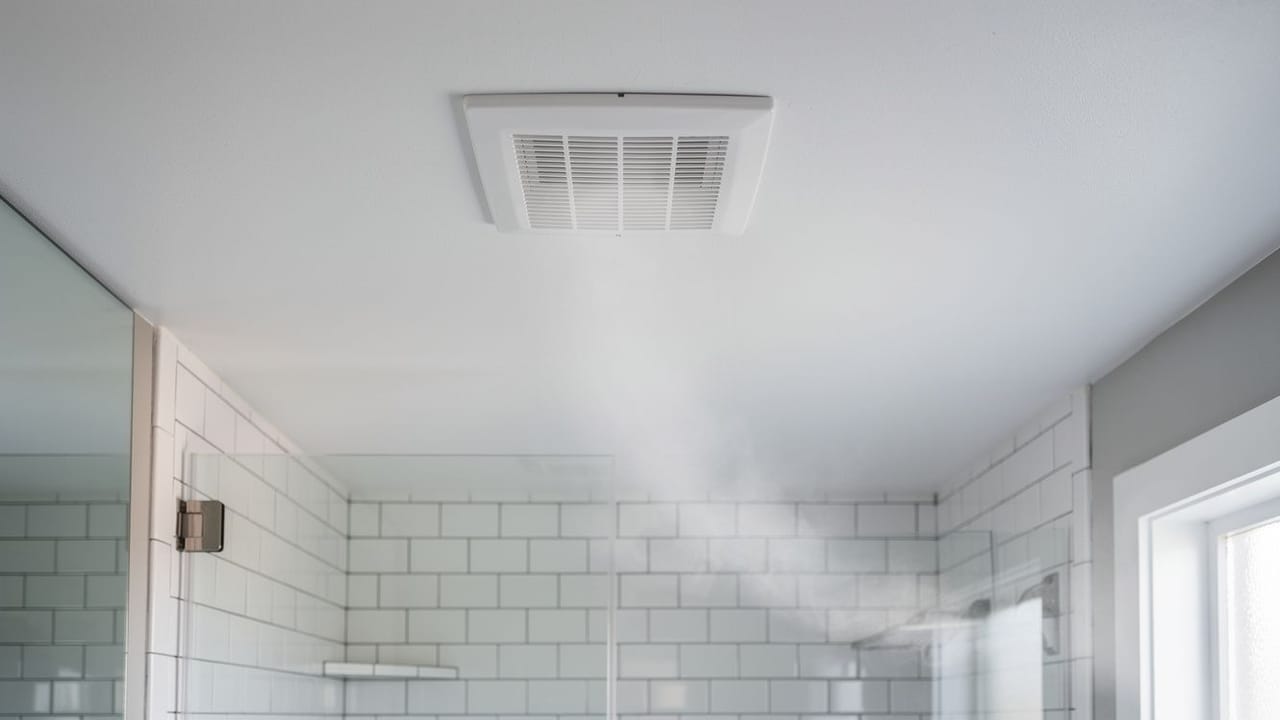
A bathroom fan has one job: get the moisture from a shower out of the house. The Department of Energy’s Building America guide to bathroom exhaust fans gives the reason, which is that keeping relative humidity down discourages condensation and the growth of mold and mildew, and it says where the air has to go: outdoors, not into an attic, a crawlspace or the space between floors. A fan that is too small, switched off too soon or ducted into the attic leaves that moisture behind.
What size bathroom fan do I need?
For bathrooms up to 100 square feet, the Home Ventilating Institute’s bathroom ventilation guidelines recommend 1 CFM of fan capacity per square foot of floor, so an 8-by-5-foot room works out to 40 CFM. HVI is the ventilation industry’s trade association, and its consumer guide to bathroom exhaust fans sets 50 CFM as the minimum for any bathroom of 50 square feet or less, so that room still gets a 50 CFM fan. Above 100 square feet, HVI sizes by fixture instead: 50 CFM each for a toilet, a shower and a tub, and 100 CFM for a jetted tub, added together.
The code floor is lower. DOE’s guide cites the 2021 International Residential Code and ASHRAE 62.2 at 50 cfm for a fan that is switched on and off, or 20 cfm for one that runs continuously. Metro Codes’ adopted codes list now names the 2024 International Residential and Mechanical Codes, and its announcement of the adoption applies them to plans and applications submitted after July 16, 2025, so on a permitted job in Davidson County we check the fan against the edition Metro enforces.
Sound rating matters practically. HVI calls a fan rated 1.0 sone or less quiet, about the sound of a refrigerator, and DOE passes on ENERGY STAR’s ceiling of 1 sone for a fan that runs continuously and 3 sones for one used on and off. When two fans both move enough air, we fit the quieter one, because a fan only clears the room while it is running.
Where should a bathroom fan vent to?
Outside, through the roof or a side wall, ending in a hooded cap with a damper that closes when the fan stops, which is the termination DOE’s guide describes. The same guide rules out the attic, the crawlspace, the garage, the space between floors and wall cavities. A fan blowing into the attic sends the bathroom’s moisture up into the roof space, where nobody sees it. For the run itself, DOE asks for smooth duct such as galvanized sheet metal or PVC in preference to flex, insulated to limit condensation, and on a wall termination sloped down and away from the fan so any water that forms drains toward the outside.
A soffit outlet is allowed, with conditions. DOE’s guide calls a short run to a soffit vent preferable to a duct snaked far past what it needs to reach the roof, provided the duct ends at its own outlet on the outside of the house, at least 3 feet from any gravity air inlet and 10 feet from any mechanical one (the distances it cites from IRC section M1504.3), and the exhaust isn’t aimed at a walkway.
- 1 CFM per square foot up to 100 square feet, by fixture above that
- Insulated duct, sloped so condensate drains outward
- Smooth rigid duct, with any flex stretched tight
- Hooded exterior cap with a damper
- Never into an attic, a crawl space, a garage or a wall cavity
Run time is what actually clears it
A fan wired to the light switch goes off when whoever showered leaves the room. HVI’s guidelines recommend leaving the fan on for 20 minutes after the bathroom is used, and DOE’s guide goes further: an hour after a shower for effective humidity control.
DOE recommends a timer switch over a standard wall switch, set so the fan shuts itself off when the time is up. A humidistat, which HVI lists alongside timers as a way to run a fan automatically, starts and stops the fan on the moisture in the room rather than on whether anyone remembered.
Signs yours is not coping
When we’re called to a bathroom that’s struggling, these are what we look for: a mirror that stays fogged long after the shower, paint peeling from the ceiling, black spotting at the ceiling edge or in the grout, and a musty smell that comes back after cleaning. Each one says moisture is staying in the room.
The EPA’s brief guide to mold and moisture says mold that keeps reappearing in a bathroom will usually stop coming back with more ventilation and more frequent cleaning, and that mold cleaned up without fixing the water problem will most likely return. So we fix the airflow first. During a bathroom remodel the fan and its duct can be resized and rerouted while the room is torn out, and the kitchen’s version of the same question is in our post on range hoods that vent outside. If your fan vents into the attic now, ask us for a free estimate.
Sources
- U.S. DOE / PNNL Building America Solution Center, Bathroom Exhaust Fans — Vent outdoors, not into attic, crawlspace, garage, floor or wall cavities; humidity, condensation and mold; 50 cfm intermittent or 20 cfm continuous (IRC 2021, ASHRAE 62.2); sone limits; hooded cap with damper; smooth insulated sloped duct; soffit outlet and M1504.3 distances; one hour on a timer; windows not relied on
- Home Ventilating Institute, Bathroom Ventilation Guidelines — 1 CFM per square foot up to 100 square feet; fixture rates above 100 square feet; run 20 minutes after use; timer
- Home Ventilating Institute, Bathroom Exhaust Fans: A Consumer Guide — 50 CFM minimum for bathrooms 50 square feet and smaller; 1.0 sone or less for quiet, about a refrigerator; timer or humidistat
- Metro Nashville Codes, Adopted Codes List — Metro has adopted the 2024 International Residential and Mechanical Codes
- Metro Nashville Codes, Metro Adopts 2024 International Building Codes — Applies to plans and applications submitted after July 16, 2025
- U.S. EPA, A Brief Guide to Mold, Moisture, and Your Home — Recurring bathroom mold: more ventilation and cleaning; mold returns if the water problem is not fixed; open a window or run the fan when showering
FAQ
Bathroom Fans and Nashville Humidity — questions
Can a bathroom fan vent into the attic?
No. DOE’s Building America guide says to duct the fan to the outside of the home, never into the attic, crawlspace, garage, the space between floors or a wall cavity. For a fan that already vents into the attic, the guide’s fix is to replace or reroute the duct so it exhausts outside, through the roof or a side wall, ending in a hooded cap with a damper.
How long should a bathroom fan run after a shower?
At least 20 minutes after the bathroom is used, by the Home Ventilating Institute’s guideline, and DOE’s Building America guide recommends a full hour after a shower. A timer switch handles it without anyone having to remember, and a humidistat control turns the fan on and off with the moisture in the room.
Does an open window work instead of a fan?
Not dependably. DOE’s Building America guide says operable windows should not be relied on for consistent bathroom ventilation, though the EPA does list opening a window while showering as one way to cut moisture. A fan ducted to the outside works whether the window is open or shut and whatever the weather is doing.
How do you vent a bathroom fan?
Run the duct to the outside through the roof or a side wall and end it in a hooded cap with a damper. DOE prefers smooth galvanized metal or PVC over flex, insulated against condensation. A short run to its own soffit outlet also works if it sits far enough from air inlets and doesn’t blow onto a walkway.