
· by Michael Blair, Nashville's Kitchen & Bath
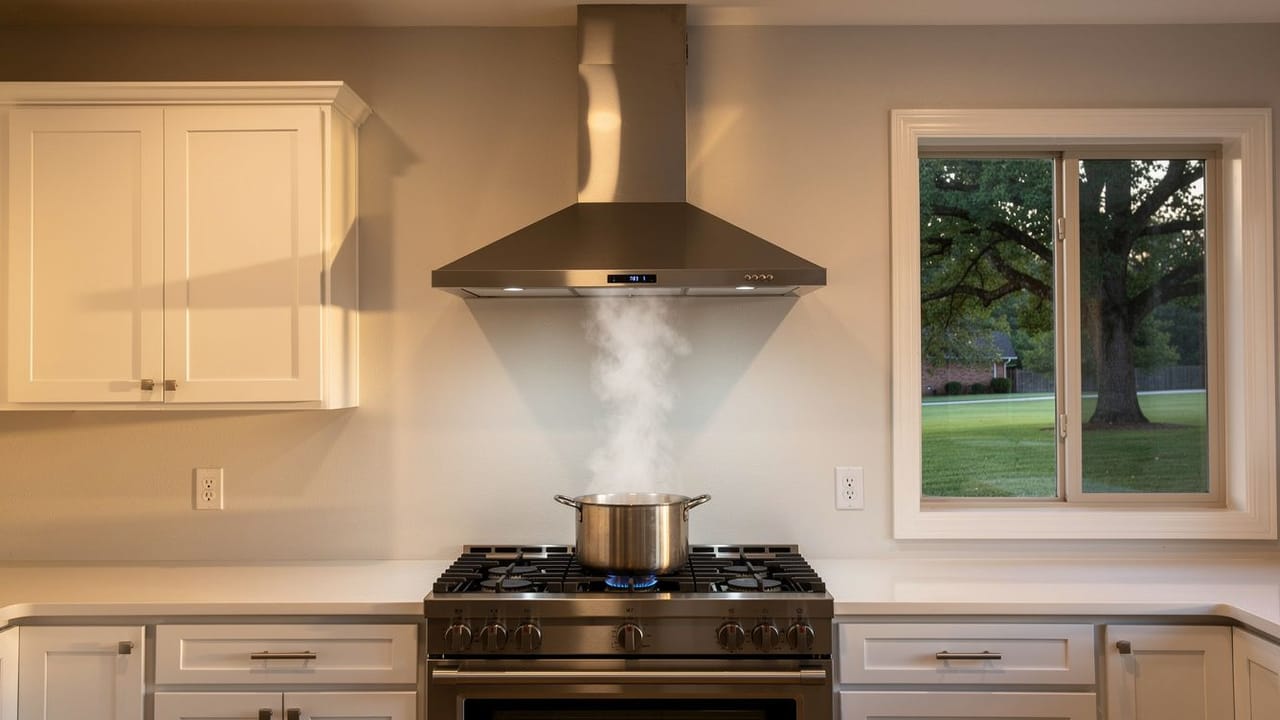
Many range hoods in existing kitchens do not vent outside. They pull air through a filter and blow it back into the room, so whatever the filter misses, the steam off a pot included, stays in the kitchen. When we plan a kitchen remodel, the route the hood’s duct will take is one of the first things we settle, because over a gas range the gap between filtering and venting is a real one.
Does a recirculating range hood do any good?
Filters do help. In a test kitchen at Lawrence Berkeley National Laboratory, both recirculating hoods with filters substantially reduced particles of every size on a gas or an induction cooktop, and the reductions were larger with gas; one of the two also lowered some volatile organic compounds. So a filtered hood earns its place over no hood at all. It still sends the air back into the room it came from.
Over a gas burner, the gases are what we care about. EPA’s page on nitrogen dioxide indoors says that in homes with gas stoves, indoor levels often exceed outdoor levels, and one of its steps to reduce exposure is an exhaust fan vented to outdoors over gas stoves. In a study of homes with gas stoves in California’s San Joaquin Valley, Berkeley Lab researchers measured nitrogen dioxide about 45 percent higher during cooking with no range hood running than with one. In a Nashville summer we would rather send the steam outside as well.
What does a ducted range hood run need?
We run smooth rigid metal duct at the diameter the hood’s installation instructions call for, with no reducer along the way, as few elbows as the layout allows and the shortest route we can find to an exterior wall or up through the roof. Ribbed flexible foil duct does not go on a hood run of ours.
The duct ends outside, at a wall or roof cap with a damper, and never in the attic, a soffit or the crawl space. EPA’s carbon monoxide guidance gives the same instruction for gas stoves: an exhaust fan vented to outdoors. Steam and grease blown into an attic have only been moved, and they can leave moisture damage above the kitchen ceiling, which is the reasoning we apply to bathroom fans in Middle Tennessee humidity too.
- Rigid metal duct, never flexible foil
- The diameter the hood specifies, not the one that fits
- Minimum elbows, shortest practical route
- Exterior termination with a backdraft damper
- Never terminate into an attic, soffit or crawl space
Makeup air, and why a big hood can misbehave
A powerful hood removes a lot of air, and that air has to come back in from somewhere. In a reasonably tight house, a big hood can pull hard enough to draw air down an open flue, such as the one on a gas water heater or furnace, and that is the case we look for.
Air coming down a flue is backdrafting, and EPA lists back-drafting from furnaces and gas water heaters among the sources of carbon monoxide in a home. In a December 2025 notice to Davidson County contractors, Metro Codes’ mechanical inspection chief called venting flue gases a life safety concern. Whether a hood needs makeup air is a code question, and Metro Nashville enforces the 2024 editions of the International Residential and Mechanical Codes, so we look up the requirement in the edition in force before we size anything. In a house with atmospherically vented gas appliances, the biggest hood on the market is seldom where we start.
Getting the size and the placement right
We size a hood to at least the width of the cooktop, wider where the cabinets allow, and mount it at the height the manufacturer’s installation instructions give rather than the height that looks right on the elevation drawing. Over a gas burner we never adjust that number by eye.
Then it has to be switched on. In the same Berkeley Lab study, the lowest pollutant levels came when the range hood ran for more than half of the cooking time, so we tell people to turn it on with the first burner and leave it running until the pans come off. If your range sits where a duct could reach outside and you want to know what the run would take, ask us for a free estimate.
Sources
- US EPA, Nitrogen Dioxide’s Impact on Indoor Air Quality — Gas stoves as an NO2 source; indoor levels often exceed outdoor in homes with gas stoves; install an exhaust fan vented to outdoors over gas stoves; venting among the most effective measures
- US EPA, Carbon Monoxide’s Impact on Indoor Air Quality — Back-drafting from furnaces and gas water heaters and gas stoves as CO sources; exhaust fan vented to outdoors over gas stoves
- Lawrence Berkeley National Laboratory, Air pollutant exposure concentrations from cooking a meal with a gas or induction cooktop and the effectiveness of two recirculating range hoods with filters (Indoor Environments, 2024) — Both filtered recirculating hoods substantially reduced all particle sizes, more so with gas; one lowered some VOCs
- Lawrence Berkeley National Laboratory, Range Hood Use and Effectiveness in Reducing Indoor Air Pollution During Gas and Induction Cooking (E3S Web of Conferences, 2026) — NO2 about 45 percent higher during gas cooking with no hood use; lowest levels when the hood ran more than half the cooking time
- Metro Nashville Codes, Adopted Codes List — Metro enforces the 2024 International Residential, Mechanical and Fuel Gas Codes
- Metro Nashville Codes, Mechanical Code Amendments Offer Clarity on Flue Venting (2025) — December 2025 notice to Davidson County contractors: venting flue gases is a life safety concern
FAQ
Range Hoods That Actually Vent Outside — questions
Can a recirculating hood be converted to vent outside?
Sometimes. Some hoods are built to run either ducted or recirculating, and the installation instructions say whether yours is one of them and what the change involves. The larger job is usually the duct, and how easy that is depends on whether the range sits on an exterior wall or in the middle of the floor plan.
Does a gas range need a vented hood?
Whether code requires one depends on the job and on the code edition, and since Metro Nashville adopted the 2024 codes we check the current rule before we quote. EPA names gas stoves as an indoor source of nitrogen dioxide and carbon monoxide, recommends an exhaust fan vented to outdoors over them, and counts venting among the most effective ways to reduce exposure.
How powerful does a range hood need to be?
Wide enough to cover the cooktop, and no stronger than its duct and the house can support. A larger hood can bring a makeup air requirement and, in a house with gas appliances venting up a flue, the risk of pulling air down it. A hood also helps only while it runs: the Berkeley Lab study of homes with gas stoves found the lowest pollutant levels when the hood ran for more than half the cooking time.
How high should a range hood be installed?
At the height in the manufacturer’s installation instructions, not the one that looks best on the elevation drawing. Over a gas burner we never adjust that figure by eye. Width counts as well, so we make a hood at least as wide as the cooktop beneath it, and wider wherever the cabinets leave room.