
· by Michael Blair, Nashville's Kitchen & Bath
The schedule describes the kitchen. It does not describe the weeks in which your house has no sink, no oven and dust on every surface, and that is the part people are unprepared for. This is what we set up before demolition on a kitchen remodel, and what to ask whoever does yours.
How long will the kitchen be out of service?
How long the kitchen is out of service depends on how much of it moves. Cabinets and counters going back on the same footprint get a shorter schedule from us than a kitchen where the sink moves, a wall comes out or an island goes in, and we put the dates in writing before demolition so you can plan around them. Some of the time passes before anyone tears anything out. In Davidson County, interior renovation goes through Metro’s permitting process, and the Codes department’s renovation permit table for one- and two-family homes puts moving a light fixture, switch or outlet, moving a plumbing fixture, and taking out a wall, load-bearing or not, on its list of work that needs one. Construction can begin only once every signoff on Metro’s checklist is in and the permit is paid for, and the page’s own advice is to allow plenty of time. That is the process behind our kitchen and bath work in Nashville.
The cabinetry is the item we watch most closely, so we have it ordered and its delivery date confirmed before demolition begins. Starting demolition against an unconfirmed cabinet date leaves a gutted room with nothing to install. A late change does the same kind of damage, because a layout revisited after the order is placed can mean reordering boxes that are already being built. That is why we settle the plan first, including the layout decisions that are hard to undo once the cabinets are on the wall.
Where should a temporary kitchen go?
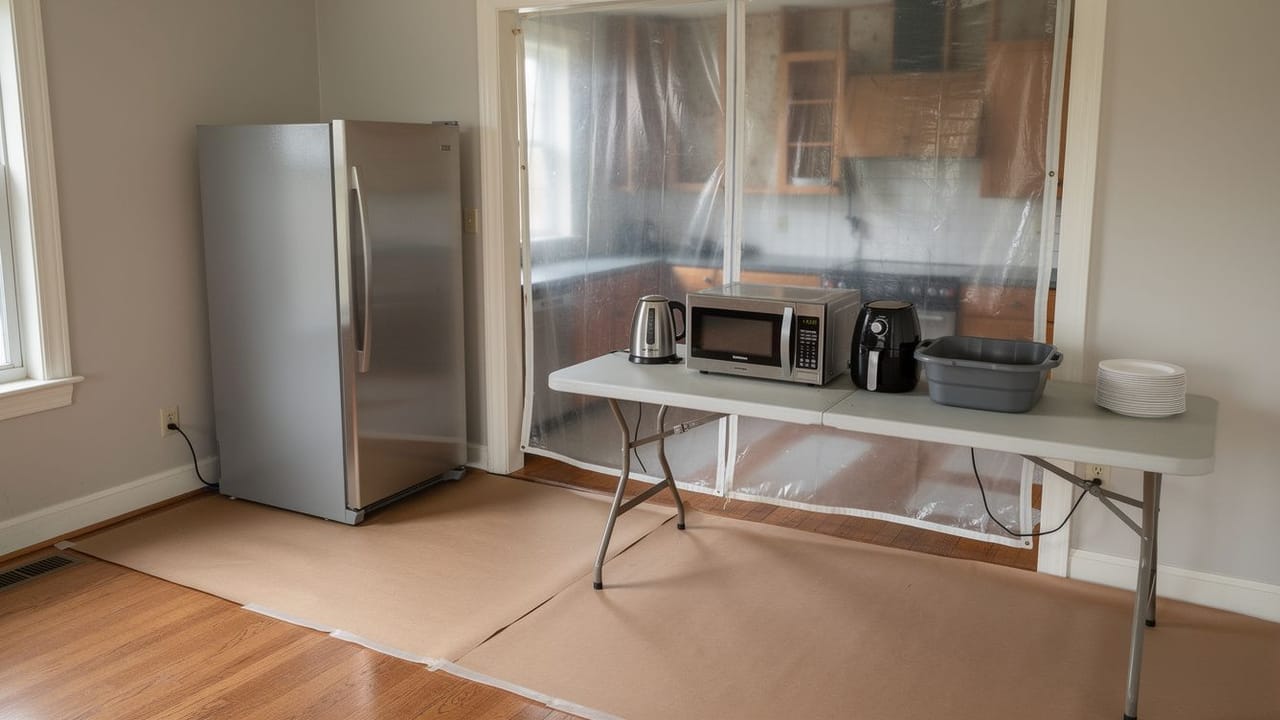
Somewhere with outlets, a surface and access to water. A dining room or garage works. Move the refrigerator there rather than living out of a cooler, and spread the plug-in appliances across more than one circuit where the house allows, instead of running the refrigerator, a hotplate and a kettle off a single extension cord.
A microwave, a kettle, an air fryer or hotplate and a plastic tub for washing up covers most of it. Paper plates until the sink is back is a reasonable trade.
- Relocate the refrigerator, not just the food
- Cooking appliances on a different circuit from the refrigerator where possible
- Microwave, kettle, hotplate or air fryer
- A washing-up plan that is not the bathroom sink
- Pack the kitchen fully before demolition day
Dust travels further than expected
We seal off the work area before demolition starts: plastic sheeting over the openings, a zip door at the one we come and go through, and the HVAC returns in the kitchen covered so the system is not drawing air from the room where the dust is.
In an older Nashville house the dust is also a question of lead. EPA says on its Renovation, Repair and Painting Program page that remodeling a pre-1978 home that has lead-based paint can easily create dangerous lead dust, and the rule that page describes requires anyone paid to disturb painted surfaces in a home built before 1978 to be certified, with their workers trained in lead-safe work practices. EPA’s Renovate Right pamphlet, last revised in September 2011, is its general guide to those requirements for homeowners and tenants.
Ask specifically whether dust containment is in the quote and what it consists of, and for a house built before 1978, whether the firm is lead-safe certified. Neither should be assumed.
Managing the last ten percent
The final stretch is trim, touch-up, hardware, appliance hookups and the punch list. On our jobs it brings several trades back for short visits, and in Davidson County, where a permit was pulled, the inspections have to fit in as well. Metro’s renovation page says the permit triggers required inspections and lets registered contractors pull the trade permits, and it makes scheduling those inspections at the proper time the applicant’s responsibility. Metro’s trades permits page adds that only licensed contractors with an e-permit account can apply online for an electrical, plumbing or gas and mechanical permit. Ask at the start who pulls each permit and who books each inspection, and verify the contractor’s license through the Tennessee Board for Licensing Contractors, which regulates contractors and home improvement contractors under Title 62, Chapter 6 of the state code.
Keep a running punch list from the first week rather than compiling one at the end. Items raised while a trade is still on site get fixed; items raised after they have left get scheduled. When you are ready to plan yours, ask us for an estimate and we will start with the schedule.
Sources
- Metro Nashville Codes and Building Safety, Renovate a Single-Family Residence — Interior renovations need a Metro permit; electrical and plumbing relocation and wall removal even if non-load-bearing need permits; checklist signoffs before construction; allow plenty of time; permit triggers inspections the applicant schedules
- Metro Nashville Codes and Building Safety, Trades Permits — Only licensed contractors with an e-permit account apply online for electrical, plumbing and gas/mechanical trade permits
- US EPA, Renovation, Repair and Painting Program — Renovation in pre-1978 homes with lead-based paint can create dangerous lead dust; paid work disturbing paint in pre-1978 homes requires certification and lead-safe training
- US EPA, Renovate Right: Important Lead Hazard Information (September 2011) — EPA’s general guide to lead-safe work practice requirements for homeowners and tenants during renovation, revised September 2011
- Tennessee Department of Commerce and Insurance, Board for Licensing Contractors — The board regulates contractors and home improvement contractors under Tenn. Code Ann. Title 62, Chapter 6, and links a license verification tool
FAQ
Living Through a Kitchen Remodel — questions
How long is a kitchen unusable during a remodel?
Plan on the whole span from demolition to the last hookups, which depends on how much of the layout moves and when the cabinets arrive, and ask for the dates in writing. On our jobs the sink and range are connected near the end, after the cabinets and countertops are in, so a room that looks close to finished may still not be usable. Where Metro issued a permit, the required inspections are part of that span too.
Should I order appliances before demolition?
Order them, and have them delivered and checked, before demolition. We draw the cabinet openings around the actual models, so a substitution because something is out of stock is far easier to absorb before the cabinets are built than after. Confirm the model numbers against the cabinet drawings.
What is the most common cause of delay?
In our experience, cabinet delivery dates and changes made after the cabinets are ordered. After those come discoveries at demolition in older Nashville homes, such as old wiring, a drain or a wall that needs more work than planned. In Davidson County, Metro lists relocating an outlet or a plumbing fixture and removing a wall, even one that is not load-bearing, as work that needs a permit, which can add a permit and inspections that were not on the original schedule.
How do you live through a kitchen remodel?
Set up a stand-in kitchen before demolition day and treat the schedule as fixed. Move the refrigerator itself, not just the food, cook with a microwave, kettle and hotplate, wash up in a tub rather than the bathroom sink, and use paper plates until the sink is back. Ask what dust containment the quote includes.