
· by Michael Blair, Nashville's Kitchen & Bath
Some kitchen sinks have a small chrome cap on the deck beside the faucet, and others do not. That cap is a dishwasher air gap, and whether a kitchen needs one is a question we answer on almost every kitchen remodel we plan, because the hole for it has to be decided before the countertop is cut.
The answer comes from two places: the plumbing code Nashville enforces, and the installation sheet for the dishwasher going in. They do not always agree, and where the sheet asks for more, we go by the sheet.
Does Nashville’s code require a dishwasher air gap?
No, the residential code Nashville enforces accepts a high loop in place of a countertop air gap. Metro adopted the 2024 codes for applications submitted after July 16, 2025, and section P2717.2 of the 2024 International Residential Code as adopted by Nashville lets the dishwasher waste connect straight to a wye fitting on the sink tailpiece, straight to the dishwasher inlet on a food waste disposer, or through an air break into a standpipe.
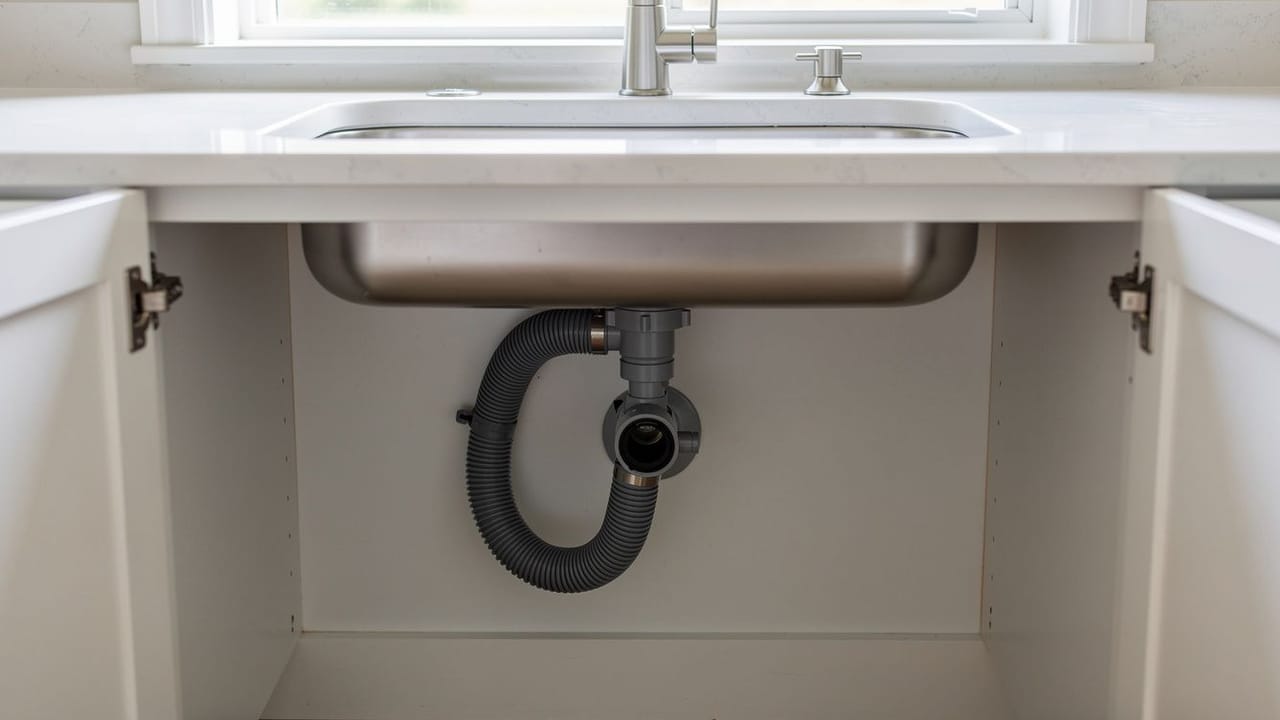
The condition is the loop. The same section says the waste line has to rise and be fastened securely to the underside of the sink rim or the countertop, and where it drains to a standpipe, it has to be fastened to the top of that pipe. A hose that runs straight across the cabinet floor to the disposal does not meet it.
The code’s other air gap is inside the machine. Section P2717.1 protects the water supply to a dishwasher with an air gap built into the unit to an ASME standard, or with a backflow preventer. That one ships in the dishwasher, and it is not the cap on the sink.
When does the dishwasher’s own sheet call for one?
The installation sheet for the machine can require a countertop air gap even where the code does not. The installation instructions for a GE built-in dishwasher give two ways to drain: through an air gap, or with a high drain loop of at least 32 inches, depending on local codes. They then make the air gap mandatory if the waste tee or disposer connection sits less than 18 inches above the floor, and they limit the drain hose to 10 feet.
Those numbers belong to that GE manual. Other makers print their own heights, so we read the sheet for the exact model on the order rather than a figure we remember from the last kitchen. A deep single-bowl sink with a disposal hung under it is the usual case where the inlet drops below 18 inches and the air gap becomes the only option the sheet allows.
Why does a dishwasher drain back up or leak at the disposal?
Most of the time the cause is the connection, not the dishwasher. GE warns that a drain without the proper connection height, meaning neither the air gap nor the 32-inch loop, will drain poorly and can cause damage. A hose that has slipped off its clip and sagged is the version of that we see after other work has been done under a sink.
A new disposal has its own catch. InSinkErator’s guide to installing a replacement disposal says the dishwasher knockout plug has to be tapped out before the drain hose is clamped on, and the loose plug lifted out from inside the unit. The plug sits in the inlet the hose connects to, so if it stays in, the dishwasher has nowhere to send its water.
Planning the drain in a kitchen remodel
In a remodel the drain gets decided with the sink and the countertop, not on install day. If the sheet for the chosen dishwasher needs an air gap, the cap needs a hole in the sink deck or the counter, and that hole goes on the drawing before the stone is templated. Our cabinets and countertops work templates quartz and granite after the boxes are set, which is the point where the faucet, soap dispenser and air gap holes are fixed.
Moving the sink changes the plan too. A sink moved into a new island needs its drain, vent and the dishwasher loop worked out together, which our post on adding a kitchen island covers from the clearance side. We plan kitchens this way across the area, Hendersonville included. If you are choosing a dishwasher and a sink now, send us both model numbers and we will tell you which drain each sheet allows.
Sources
- 2024 International Residential Code as adopted by Nashville, Chapter 27, P2717 — Dishwasher water supply protection (P2717.1) and the waste connection, high loop and standpipe rule (P2717.2).
- Metro Nashville Codes, Metro adopts 2024 International Building Codes — The 2024 codes apply to applications submitted after July 16, 2025.
- GE Appliances, built-in dishwasher installation instructions — Air gap or 32-inch high loop, air gap required below an 18-inch connection, 10-foot hose limit.
- InSinkErator, installing a replacement garbage disposal — Removing the dishwasher knockout plug before connecting the drain hose.
FAQ
Does a Dishwasher Need an Air Gap in Nashville? — questions
Is a high loop as good as an air gap for a dishwasher?
Under Nashville’s 2024 residential code it is an accepted way to connect, as long as the hose rises to the underside of the counter and is fastened there. Some install sheets are stricter. GE’s requires an air gap when the disposal or tee connection is below 18 inches, so the model on the order decides it.
Where does the dishwasher hose have to be fastened under the sink?
The code asks for the hose to rise to the underside of the sink rim or countertop and be fastened there. The maker may set a number as well: the GE built-in manual we read asks for a loop of at least 32 inches. Check the installation sheet for your model, because the heights differ.
Do you have to knock out the disposal plug for a dishwasher?
Yes, when the dishwasher drains into the disposal. InSinkErator’s instructions say to tap the knockout plug out of the dishwasher inlet with a screwdriver and hammer, then remove the loose plug from inside the unit. Left in place, it blocks the inlet, so the dishwasher cannot drain through the disposal at all.
Can a dishwasher drain into a standpipe instead of the sink?
Yes. Section P2717.2 of Nashville’s 2024 residential code lets the dishwasher waste discharge through an air break into a standpipe, provided the hose is fastened securely to the top of that standpipe. The other two options it allows are a wye on the sink tailpiece and the dishwasher inlet on a disposal.
What is the air gap built into a dishwasher for?
It protects the water coming into the machine rather than the drain going out. Section P2717.1 of the code requires the dishwasher’s water supply to be guarded against backflow, either by an air gap built into the unit to an ASME standard or by a separate backflow preventer. It is not the cap on the sink.